Order Quality Trees Online – Delivered Straight to Your Door
Welcome to Our Online Plant Store
From our nursery to your backyard — it’s never been easier to create the garden you’ve been dreaming of. Whether you’re after statement trees, hedging, or lush planting to fill your outdoor spaces, you can now browse and order directly online.
We provide an extensive range of high-quality plants and trees that are perfect for residential landscapes — all backed by the same expert care and service we’re known for. No trade account needed, no back-and-forth calls. Just beautiful plants, delivered to your door.
Shop by category
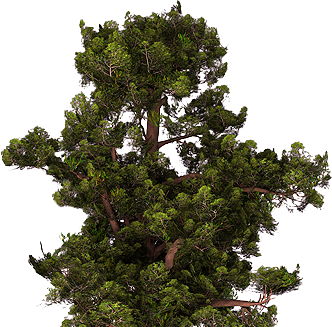
New Zealand Native Trees
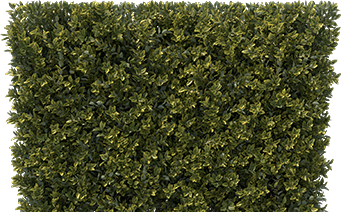
Hedging Plants
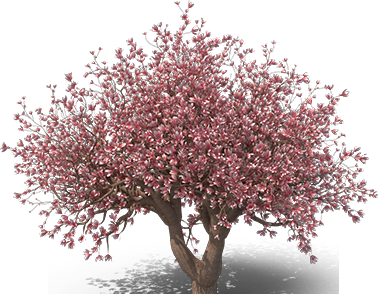
Flowering Trees

Evergreen Exotic Trees
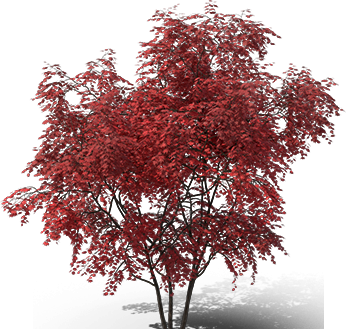
Deciduous trees
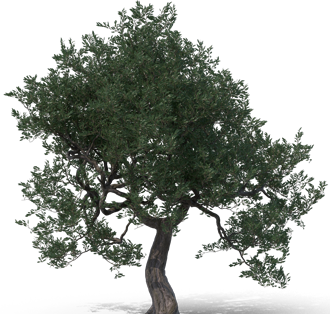
Character Olive Trees
Browse all Trees
- A fast growing, large tree from central America. With its broad, rounded canopy of lush green foliage, this tree is an exceptional choice for providing ample shade in spacious areas. Evergreen. Grows to apx 10 x 8m
- Gleditsia tricanthos ‘Ruby Lace’, also known as Honey Locust, is a graceful deciduous tree. It forms a small, round-headed canopy with elegantly spreading, arching branches that add charm to any garden. In summer, finely divided foliage emerges in a striking purple-red. As the season shifts, the leaves intensify to bronze-red before falling in autumn, creating vibrant seasonal colour. Originating from the United States, ‘Ruby Lace’ adapts well to diverse soil conditions. It tolerates compacted, clay, poor-quality, and drought-prone soils, making it highly resilient. Moreover, this tree withstands heat, salt, and harsh urban environments. As an added benefit, it fixes nitrogen, which improves soil health and supports long-term growth. With its umbrella-shaped crown, ‘Ruby Lace’ makes an excellent shade tree for smaller gardens. Growing to approximately 5m tall and 4m wide, it offers beauty and practicality in compact spaces.
- Gleditsia triacanthos ‘Skyline’, or Honey Locust, is an upright spreading tree with a compact branching structure. Its dense, finely divided foliage is deep green through summer, turning a striking golden yellow in autumn. This hardy tree tolerates a wide range of soils, including sandy, loamy, and heavy clay. It grows best in well-drained soil but adapts to very dry periods. With full sun, it thrives in wind, coastal, and heat-exposed sites. Reaching approximately 6 x 4 metres, Honey Locust makes an excellent specimen, shade, or livestock shade tree. (ASPCA Ok - recommend own peace of mind research) Its resilience and adaptability ensure reliable performance across diverse conditions.
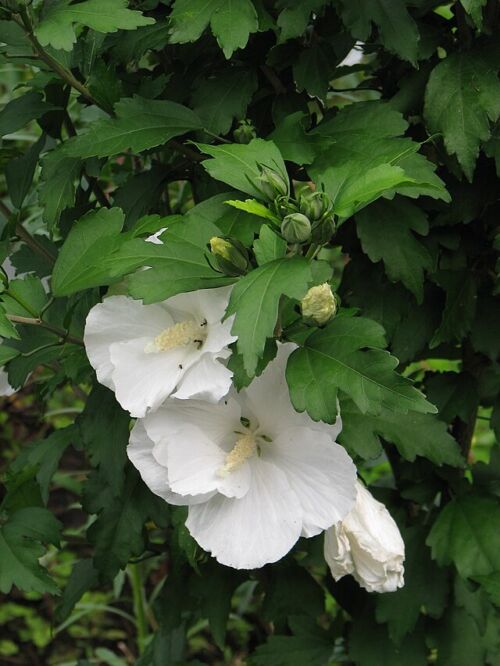
- Hibiscus syriacus ‘Diana’ is celebrated for its abundant blooms and long flowering season. This award-winning deciduous shrub is compact, making it perfect for smaller gardens or urban spaces. Its pure white, saucer-shaped flowers can reach up to 12 cm wide. With slightly wavy petals, they offer a soft elegance that stands out against green foliage. Unlike most hibiscus varieties, ‘Diana’ blooms stay open through the night. This ensures continuous beauty from mid-summer until the first frost. Each flower lasts about a day, while the foliage shifts from lush green to golden-yellow in autumn, adding seasonal interest. It thrives in full sun and prefers moist, well-drained soil. For best results, plant in a sheltered position to protect from harsh winds. ‘Diana’ is easily trimmed to shape and makes an excellent potted plant. It grows to approximately 1.5 meters tall and 1.2 meters wide.
- Juniperus chinensis ‘Kaizuka’, also known as Hollywood Juniper, is a striking evergreen renowned for its sculptural form. Its branches spiral upward in a distinctly twisting motion, adorned with vivid bright green foliage that adds year-round interest. Thanks to its versatility, this variety can be left to grow naturally or trimmed into soft, rounded pillows—creating the illusion of floating clouds in the landscape. Moreover, it tolerates drought, wind, and coastal conditions, making it a resilient and adaptable choice. As a result, it serves as a unique focal point in any garden setting. With moderately fast growth and parentage rooted in China and Japan, it brings both elegance and heritage to outdoor spaces. Importantly, it requires good drainage to thrive.
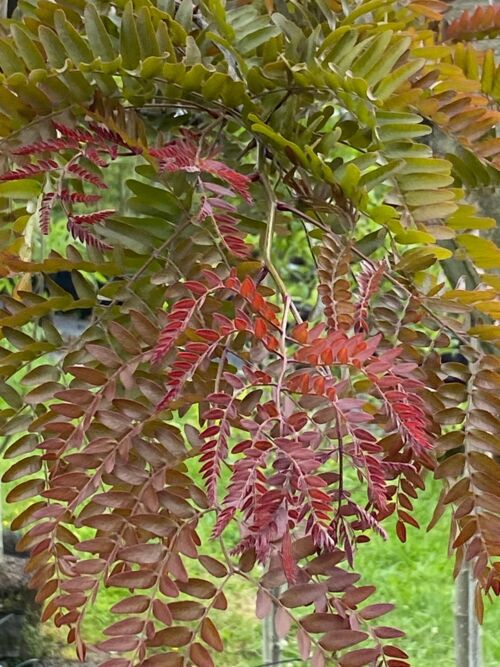
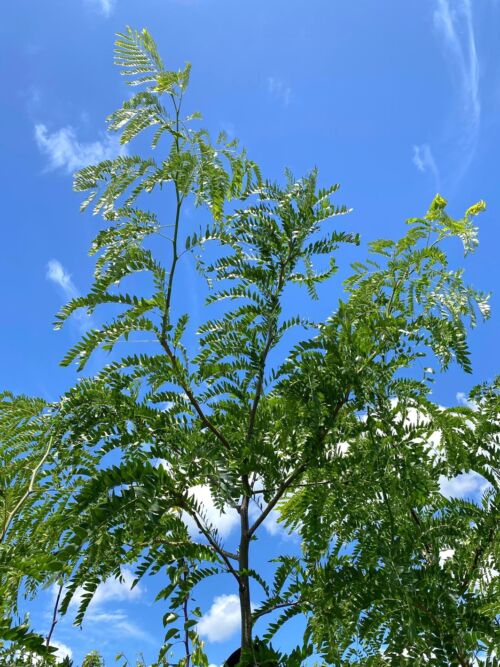
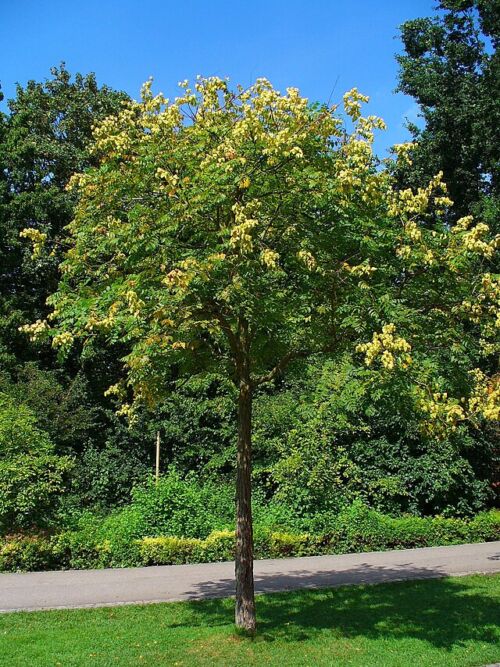
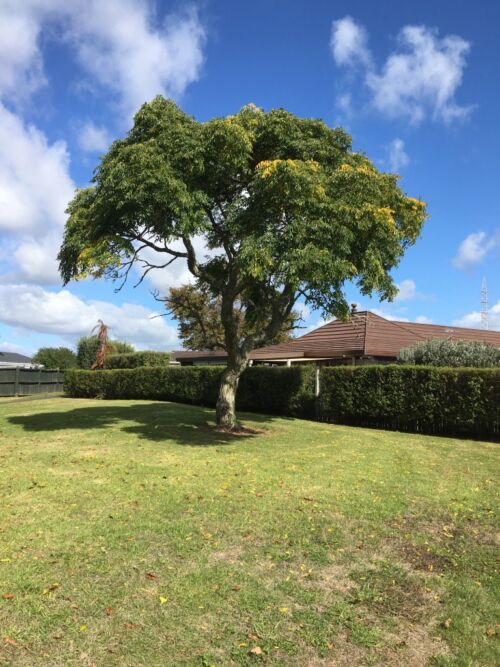
- Koelreuteria paniculata, known as the Golden Rain Tree, is a medium‑sized deciduous tree with a broad, spreading canopy. Its long pinnate leaves emerge pinkish in spring, mature to green in summer, and turn a brilliant yellow in autumn. In early summer, elongated panicles of golden‑yellow flowers appear, creating a magnificent display. With origins in China, Korea, and Japan, this tree is hardy once established, tolerating heat, drought, and urban conditions with ease. Highly adaptable, the Golden Rain Tree grows in clay, loam, or sandy soils. Moreover, it can thrive even in nutritionally poor soils, although it will not tolerate waterlogged ground. Compact yet striking, it grows to approximately 5m tall by 4m wide, making it a standout specimen for smaller gardens or feature plantings.
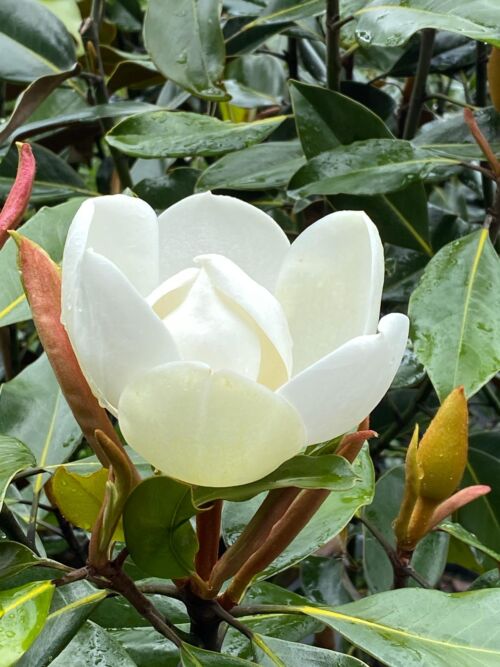
- Magnolia grandiflora ‘Kay Parris’ is a compact evergreen tree with upright growth that responds well to pruning. Its shiny green, wavy leaves feature coppery brown felt on the undersides, adding texture and contrast throughout the year. From spring through summer, it produces large, fragrant white flowers that enhance its ornamental appeal. As a seedling variation of ‘Little Gem’, it’s both vigorous and versatile—ideal for screening, hedging, or as a standalone feature in smaller gardens. It thrives in full sun and prefers moist, well-drained soil. While it tolerates clay, avoid overly wet conditions. Typically, it reaches 4 × 3 metres and can be pruned to suit your space.
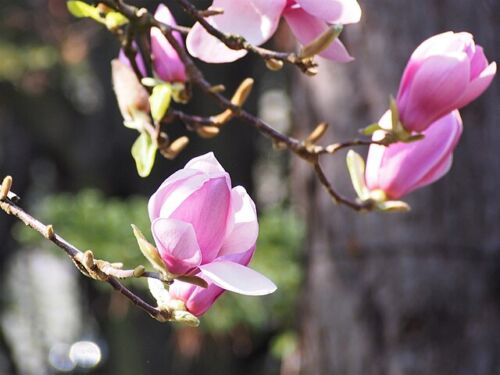
- Magnolia ‘Iolanthe’ is a deciduous tree bred in New Zealand as part of the renowned Jury hybrid series. It develops into a large, rounded tree with an open branching habit, creating a graceful structure in the landscape. During summer, leathery green leaves form a lush canopy. From early spring, the tree bursts into masses of very large, lavender-pink, bowl-shaped flowers, delivering a spectacular seasonal display. It thrives in full sun and prefers moist, well-drained soil in a sheltered position. Growing to approximately 8 × 3.5 metres, it makes an excellent shade tree and a standout garden feature.
- Melia azedarach – Indian Bead Tree is a round-headed deciduous tree with glossy, compound green leaves. In spring, it produces scented pale lilac flowers. Later, during autumn, loose clusters of smooth oval berries appear, turning from green to bright yellow in winter. Not to be eaten. Tthe tree adapts well to a wide range of soils, provided they are well drained to prevent root rot. It grows best in full sun. Moreover, pruning helps open the crown and encourages the development of well-spaced limbs. Thanks to its dense leaf covering, it is ideal as a lawn specimen or shade tree. This hardy tree withstands frost, wind, and occasional dry periods. Finally, it reaches approximately 7m tall and 5m wide, making it a striking addition to any landscape.
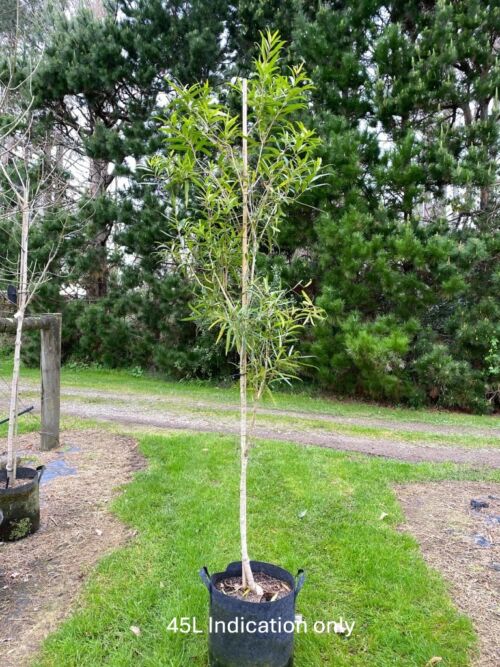
- A domed shaped tree grows readily on a clear stem, and can be maintained at a wide variety of heights. Long green linear leaves that can measure up to 100 x 10 millimetres. Slender branches. Found from coast to high altitude forest. The tree’s slender, elongated leaves give the tree a light, airy elegance.
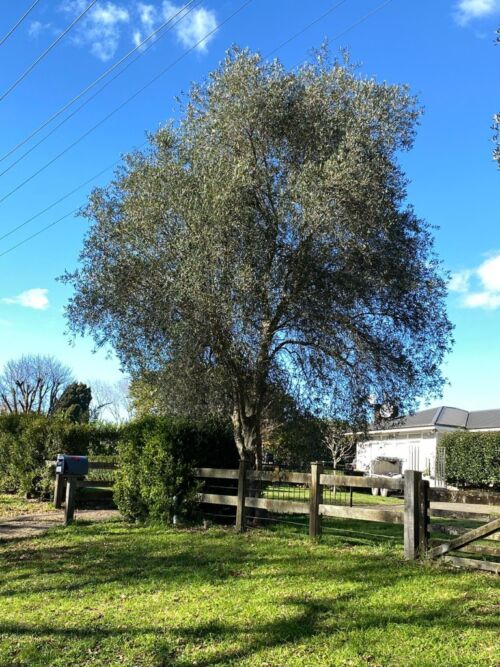
- Olea europaea ‘Ascolano’ is a rounded, moderately fast-growing evergreen with a bushy habit. It features silvery-green, leathery leaves and strong, rigid branches. This variety is well known for producing large, mild table olives, making it both ornamental and productive. Ascolano is suitable for hedging or screening and can also be left to grow as a specimen tree. When mature, it reaches approximately 6 x 3 metres, offering structure and beauty in the landscape. Originating from the Marche and Tuscany regions of Italy, Ascolano thrives in full sun and well-drained soil. Once established, it tolerates wind, coastal conditions, and dry spells, making it a hardy and versatile choice for gardens.
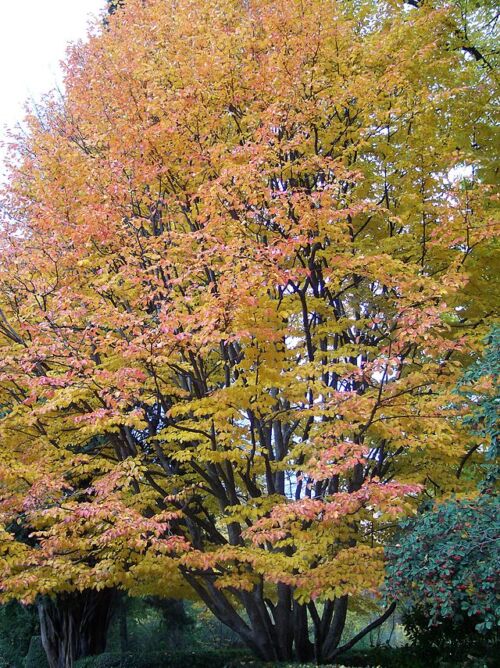
- Parrotia persica – Persian Ironwood is a compact, deciduous tree known for its exceptional autumn colour. Originating from Iran, it’s considered one of the finest small trees for seasonal interest. The botanical term persica refers to its Persian roots, highlighting its natural heritage. This slow-growing, broad-spreading tree often develops multiple stems and features attractive, flaking bark. Its dark green leaves shift dramatically in autumn, turning vivid shades of yellow, orange, rosy pink, and scarlet. In late winter to early spring, clusters of unusual red flowers appear on bare twigs, adding early-season charm. Persian Ironwood tolerates clay soils, though it’s best to avoid overly wet conditions. With a mature size of approximately 8 meters tall and 6 meters wide, it makes an excellent specimen tree.


Why buy online?
Buying plants and trees online doesn’t have to feel risky or impersonal. At Black Bridge Nurseries, we’ve made it simple, safe, and satisfying — so you can shop with confidence, from the comfort of home.