Avenue Trees
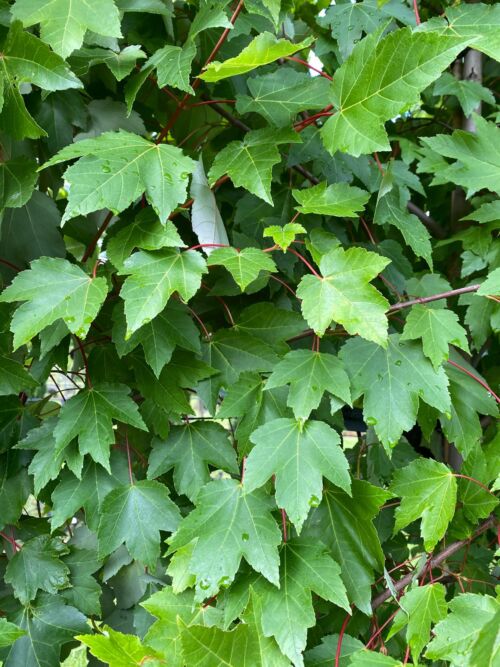
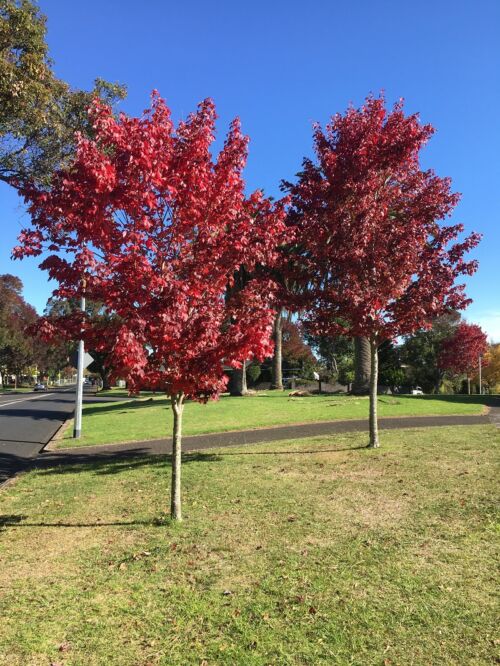
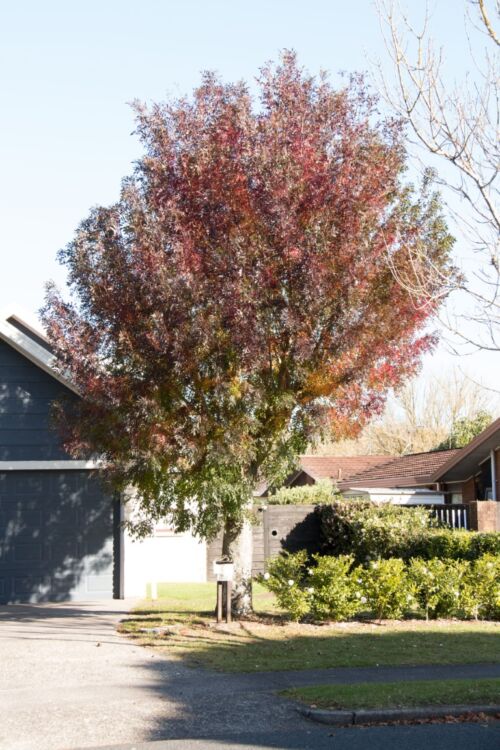
- Acer freemanii ‘Autumn Blaze’, also known as the Freeman Maple, is a deciduous, admired Red Maple cultivar. Green leaves with a grey back, adorn the branches. Over autumn vibrant red creates a wonderful seasonal display, making it a favourite for landscape designers and homeowners alike. In early spring, striking red tassel flowers appear in dense clusters before the leaves emerge. These are soon followed by decorative winged seeds, adding further seasonal interest. ‘Autumn Blaze’ adapts well to a range of soil conditions, including poor soils. It grows at a medium to fast rate and typically reaches around 12 metres tall and 8 metres wide. Thanks to its tidy, upright, and compact growth habit, this tree is ideal as a shade tree or as avenue plantings.
- Acer freemanii ‘Jeffers Red’ – Freeman Maple is a fast-growing, upright, deciduous tree featuring strong ascending branches and a dense, broad-oval crown. Its rich green summer foliage transforms into brilliant red in autumn, creating a stunning seasonal display. It thrives in moist, well-drained soil but adapts to clay, poor, wet, or dry conditions. More wind-tolerant than other maples. Ideal as a specimen or avenue tree, it reaches approximately 10m tall by 5m wide.
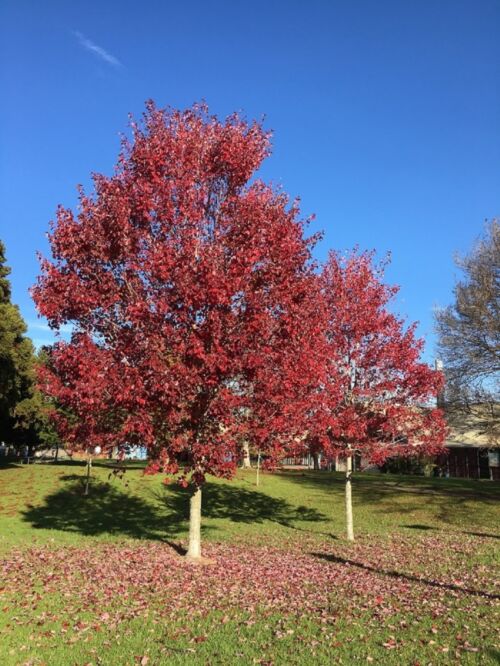
- Acer rubrum ‘Autumn Glory’, also known as Red Canadian Maple, stands out as one of the most admired Red Maple cultivars. Its vibrant red foliage in autumn creates a breathtaking seasonal display, making it a favourite for landscape designers and homeowners alike. Thanks to its tidy, upright, and compact growth habit, this deciduous tree is ideal for residential gardens and street plantings. Compared to other rubrum varieties, it offers a more manageable size and shape. In early spring, striking red tassel flowers appear in dense clusters before the leaves emerge. These are soon followed by decorative winged seeds, adding further seasonal interest. Moreover, ‘Autumn Glory’ adapts well to a range of soil conditions, including poor soils. It grows at a medium to fast rate and typically reaches around 12 metres tall and 8 metres wide. In the Northern Hemisphere, this cultivar is often referred to as ‘October Glory’, in line with their autumn season.
- Acer rubrum ‘Bowhall’, commonly known as the Upright Red Maple, is a fast-growing, deciduous tree with a narrow, columnar form, ideal for tight spaces. Its strongly upright branches support glossy dark green leaves with silvery undersides, creating a striking contrast. In autumn, the foliage transforms into brilliant shades of yellow, orange, and reddish-orange, adding vibrant seasonal colour. This hardy tree adapts well to a wide range of soil conditions, from damp to dry, including clay and sandy soils. Native to North America, Bowhall is perfect for avenues, street plantings, or as a lawn specimen where space is limited. Mature height reaches approximately 12 metres with a spread of 3 metres.
- Acer saccharum, commonly known as the Sugar Maple, is famed as the iconic source of traditional maple syrup. Cultivated commercially for its sap, which is boiled down into the sweet "Maple Syrup" loved worldwide, this tree is as practical as it is beautiful. As a tree it’s fast-growing, deciduous, with a broad, rounded canopy making it an excellent shade tree. Its large, lobed green leaves with a silver underside transform into a spectacular display of red, orange, and yellow in autumn. This makes it a seasonal showstopper! They prefer fertile, moist, well-drained soil as it doesn’t like overly dry or poorly draining sites. The Sugar Maple leaf is proudly recognized as the national emblem of Canada, celebrated for its grace and cultural significance. In the landscape they are ideal as a specimen tree, for avenue plantings as they add seasonal interest and shade to larger gardens or open spaces. Size at Maturity apx 10 x 7 metres
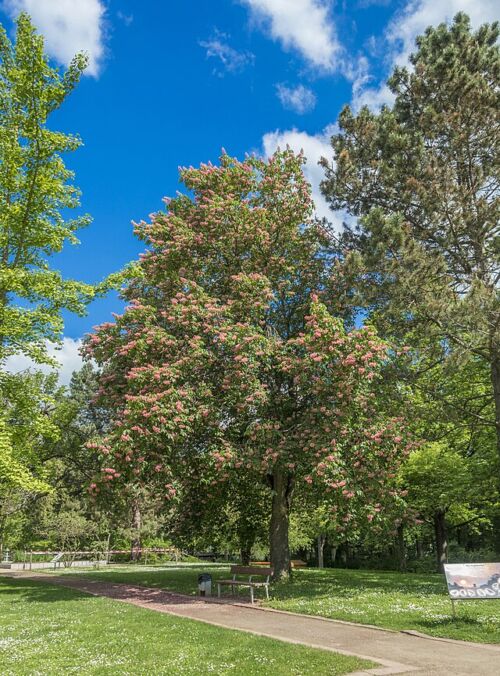
- Aesculus carnea – Red Horse Chestnut is a deciduous, wide, round-headed tree that looks stunning when in flower. More compact than the common horse chestnut, it features large, dark green, fan-shaped leaves that provide a lush backdrop. In spring and early summer, giant pink-red candle-like flowers appear, each with a hint of yellow in the throat. These striking blooms make the tree a standout feature in any landscape. The Red Horse Chestnut thrives in moist, fertile, well-drained soils. Moreover, it prefers a temperate climate with full sun to partial shade. Hardy and resilient, it tolerates urban conditions well, making it versatile for different settings. This tree is excellent for shade, avenues, parks, or farms. Typically, it grows to approximately 9m tall by 7m wide, forming a bold and impressive specimen.
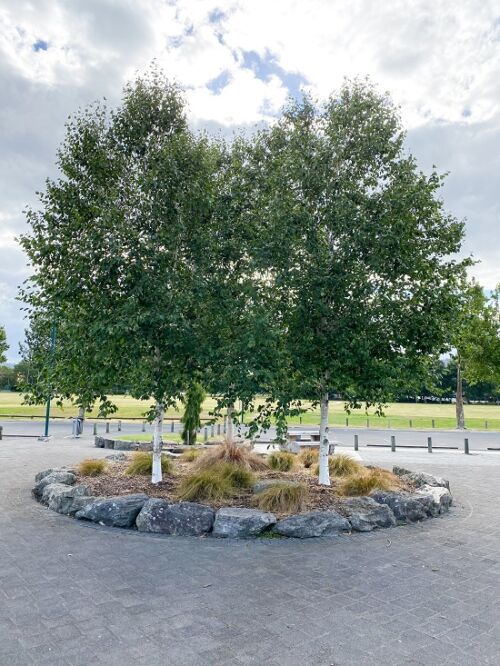
- Strong in form, Betula ermanii – Erman’s Birch is a deciduous tree with a naturally neat, conical to pyramidal shape—especially when its central leader is maintained. As the seasons progress, its bark peels away in elegant layers of creamy white or subtly pink-tinged sheets, offering year-round ornamental appeal. Throughout the growing season, its coarsely toothed, ovate leaves remain a deep green. Then, as autumn sets in, they shift to a bold, brilliant yellow, adding vibrant contrast to the landscape. Come spring, yellow-brown male catkins unfurl alongside fresh foliage, marking the tree’s seasonal renewal. Originating from northeast Asia, this species is well-suited to urban environments. Whether used as a stately avenue tree or for light shade, it performs reliably and with distinction. At full maturity, Erman’s Birch can reach heights of up to 15 metres and 6 metres wide, making it a commanding for structured plantings.
- 15 x 6m
- Tall 10+m
- Moderate - Fast
- Tree
- conical to pyramidal
- Northeast Asia
- Betula Jacquemontii, Poplar Crows nest
- Green
- Yellow
- Moist well drained
- Hardy
- Bold and architectural, Betula utilis 'Jacquemontii' or the Himalayan Birch is a medium-sized deciduous tree known for its upright form that gradually matures into a broad oval silhouette. Originating from the rugged terrains of China and the Himalayas, this fast-growing variety commands attention with its striking, powdery-white bark—a signature feature that sets it apart in any landscape. Throughout summer, its dark green foliage offers a rich contrast to the luminous trunk, before shifting to warm yellow hues in autumn, adding seasonal interest. Whether planted in structured avenues or grouped for visual impact, this birch delivers a refined yet natural presence. Additionally, it responds well to topping, allowing for the creation of standard-type trees where desired. Typically reaching approximately 7 metres in height and 3 metres in spread, Betula 'Jacquemontii' is a standout choice for those seeking elegance with a touch of rugged charm. Utilis = Useful
- Carpinus betulus 'Fastigiata', commonly known as Upright Hornbeam, is a deciduous tree with a narrow, columnar form that gradually broadens as it matures. This refined cultivar of the European Hornbeam remains in its tight form making it ideal for structured landscapes, offering both formality and seasonal interest. During summer, its oval, ribbed green leaves create a lush canopy. As autumn arrives, the foliage transitions into warm shades of yellow and orange, eventually turning brown and remaining on the tree well into winter adding texture and colour even in the colder months. Moreover, this tree thrives in moist, well-drained soil and prefers a sunny position. Thanks to its upright habit and tolerance for close planting, it makes an excellent choice for street planting, avenues, or as a screen. Reaching approximately 8 metres tall and 3 metres wide, The Upright Hornbeam is a versatile and low-maintenance option for both urban and rural settings.
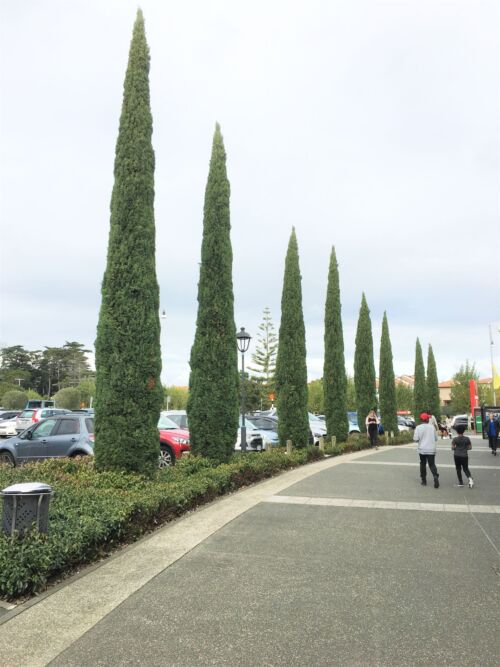
- Cupressus sempervirens 'Totem', commonly known as Totem Cypress, is a tightly upright-growing conifer with striking bluish-green foliage. Notably, these trees are iconic in Italy—especially throughout Tuscany—where they define the landscape and grace Renaissance gardens with timeless elegance. Thanks to their slender, vertical form, Totem Cypresses create bold architectural accents that elevate formal landscapes. Moreover, this cutting-grown cultivar ensures a consistently narrow columnar shape and even growth rate, making it a reliable choice for symmetry and structure. Unlike other varieties, its foliage remains dense and intact, resisting the tendency to “fall out.” Additionally, it offers improved resistance to fungal canker, making it a hardy option for challenging conditions. Often planted in rows as living pillars, it’s ideal for lining entranceways and avenues with a commanding presence. For optimal performance, Totem Cypress prefers drier soil and well-drained sites. Ultimately, it grows to approximately 10 meters tall and 2 meters wide delivering a bold, sculptural impact wherever it’s planted.
- Fagus sylvatica ‘Riversii’ – Rivers Purple Beech is a striking, round-shaped deciduous tree. Its deep purple-red, almost black leaves have wavy margins and drop cleanly in winter, creating a bold seasonal display. Originally developed in England, this variety was introduced by Thomas Rivers’ nursery around 1860. It remains the darkest of the copper beeches, admired for its dramatic foliage and heritage value. The Riversii Beech thrives in moist, well-drained soil and full sun, which enhances its rich colour. It grows to approximately 10 x 5 metres, making it an excellent shade tree for parks, avenues, and spacious landscapes.
- Fagus sylvatica 'Dawyck' is a tall, columnar deciduous tree with a distinctly upright habit and moderate growth rate. Over time, its narrow form broadens, adding architectural style to any landscape. In early spring, its vertical branches are cloaked in bright glossy green leaves. As the seasons shift, the foliage transforms into a warm cinnamon brown over autumn. Thanks to its slender profile, 'Dawyck' is ideal for planting where space is limited—whether beside pathways, framing entrances, or standing as bold vertical accents. With origins in Scotland, it brings both heritage and sophistication to gardens and urban settings alike. Typically reaching around 8.0m in height and 2.5m in width, this beech variety is a standout specimen for structured planting schemes or formal avenues.
- Fraxinus excelsior ‘Purple Spire’, commonly known as Purple Ash, is a deciduous, upright-growing tree with a remarkably even branching structure. Over time, it develops into an oval shape, with a moderate to fast growth rate. Throughout spring and summer, it bears glossy green foliage that transforms into striking shades of purple and orange in autumn, adding seasonal interest. Interestingly, this cultivar was developed in New Zealand, although its Fraxinus parentage traces back to Europe. Ideally, it prefers moist, well-drained soil and will tolerate some wind, making it a resilient choice for various landscapes. As such, it’s excellent for planting along streets, avenues, or long driveways. Typically, it reaches approximately 8 x 4 metres, offering structure and colour without overwhelming smaller spaces. PVR Pending
-
- Description
A distinct pyramidal form in its early years, matures to a large rounded, broad spreading tree. Green leaves in summer are narrow and serrated, and transform to a vibrant, deep red colour in autumn, earning it the name "Claret Ash" Hardy to a wide range of conditions. Excellent landscaping, street, specimen or shade tree. Height x Width 15 x 8 Height Range Tall 10+ Growth Rate Fast Plant Type Tree Shape / Habit Round Country of Origin Australia Similar to Consider Prunus Thundercloud, Fagus Riversii, Fagus Sylv Purp, Acer Tamuke Yama, Acer Bloodgood. - Leaf
Leaf Colour Green Deciduous Leaf Colour Red - Flower
Flower Nil - Uses
Specimen Yes Good Shade Tree? Yes Accent Yes Note: Growth, height and grade information are given in good faith but are subject to natural variables beyond our control. - A fast growing, large tree from central America. With its broad, rounded canopy of lush green foliage, this tree is an exceptional choice for providing ample shade in spacious areas. Evergreen. Grows to apx 10 x 8m
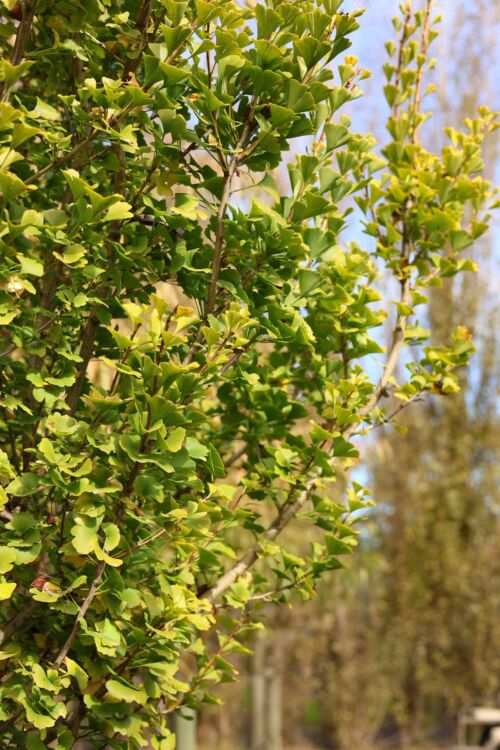
- Ginkgo biloba – Maidenhair Tree is a hardy, deciduous tree with an ancient heritage originating in China. It develops into a graceful pyramidal form, featuring symmetrical branches and distinctive grey, corky bark. During summer, broad fan-shaped leaves emerge, resembling sections of a maidenhair fern. These leathery, light-green leaves create a lush canopy. As the seasons change, the tree transforms with spectacular autumn colour, displaying bright golden-yellow foliage that lasts for an extended period. This tree thrives best in moist, well-drained soil. Moreover, it will tolerate clay conditions, provided the site is not waterlogged. For optimal growth, plant in full sun. Mature specimens typically reach around 6 metres high and 4 metres wide, making them ideal for both gardens and landscapes.
- Ginkgo biloba ‘Autumn Gold’ – Maidenhair Tree is a spectacular male clone from the renowned Ginkgo family. Because it is a selected male variety, it will not produce unpleasant fruit. Developed in San Jose, California, this tree grows with a pyramidal shape, featuring symmetrical branches and distinctive grey, corky bark. Its broad, fan-shaped leaves resemble sections of a maidenhair fern. Throughout summer, the foliage is light green and leathery. As autumn arrives, the tree transforms with brilliant golden-yellow colour that lasts for an extended period, creating a striking seasonal display. ‘Autumn Gold’ thrives in moist, well-drained soil. Moreover, it will tolerate clay conditions, provided the site is not waterlogged. For best growth, plant in a sunny position. Mature specimens typically reach around 6 metres high and 4 metres wide, making this an excellent specimen tree for gardens and landscapes.
- Ginkgo biloba ‘Fastigiata’ – Upright Ginkgo is a deciduous tree with a very neat, upright form. As a selected male variety, it will not produce unpleasant fruit. Its deep green, distinctive maidenhair leaves turn golden yellow in autumn, creating a striking seasonal display. The ‘Fastigiata’ cultivar was discovered and selected in France. By the 1980s, it had emerged as a popular narrow form, valued for its elegant shape and suitability in restricted spaces. This tree is highly effective in narrow streets, tight spaces, and small home gardens. Moreover, it can be trimmed to maintain an even neater appearance, making it versatile for both urban and residential landscapes. It thrives in moist, well-drained soil and will tolerate clay conditions, provided the site is not waterlogged. For best growth, plant in a sunny position. Mature specimens typically reach around 7 metres high and 3 metres wide.
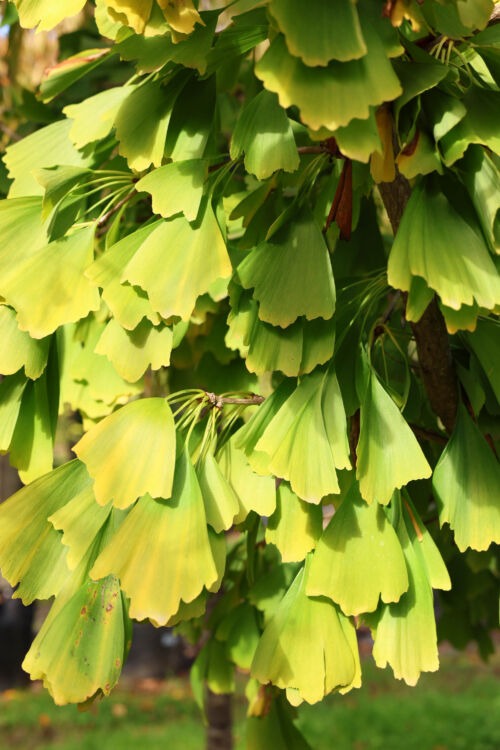
- Ginkgo biloba ‘Saratoga’ is a striking deciduous tree renowned for its spectacular autumn colour. Unlike female varieties, ‘Saratoga’ is a selected male clone, meaning it will not produce unpleasant fruit. Its upright growth habit makes it a graceful choice for gardens and landscapes. The tree’s distinctive long green leaves hang downward, creating a pendulous, weeping effect. During autumn, these leaves transform into a brilliant golden yellow, offering a breath taking seasonal display that lasts for weeks. Although Ginkgo trees are native to China, the ‘Saratoga’ variety was developed in the United States. It originated in the 1970s when the Saratoga Horticultural Research Foundation in California selected it from a seedling, ensuring its unique qualities. This tree thrives in moist, well-drained soil. Furthermore, it will tolerate clay conditions as long as the site is not waterlogged. For best results, plant in full sun. Mature specimens typically reach 7 metres high and 5 metres wide, making them ideal for both private gardens and larger landscapes.
- Knightia excelsa, commonly known as Rewarewa, is a striking evergreen native to New Zealand. It forms a slender, erect, and tapering tree with long, green serrated leaves that adds texture and structure to the landscape. In spring, it produces very unusual tubular reddish-brown flowers with yellow tips that are highly attractive to native birds, adding both ecological value and seasonal interest. Because of its upright habit, Rewarewa is ideal for smaller gardens and narrow spaces. Additionally, it is well-suited to coastal gardens. While it tolerates clay soils, overly wet conditions should be avoided. Likewise, phosphate-based fertilizers are not recommended. Typically, it grows to approximately 7 x 3 metres, making it a manageable yet elegant choice for urban and rural settings alike. Interestingly, the Latin name Excelsa refers to its tall, strong stature.
- 7 x 3m
- Medium 5-10m
- Moderate
- Tree
- Columnar
- Evergreen
- New Zealand
- Liriodendron tulipifera fastigiata, Olea El Greco, Dacrydium Cupressinum, Acer Bowall, Poplar crow’s nest, Quercus robur fastigiata, Carpinus Betulus fastigiata, Dacrycarpus Dacrydoidies, Cupressus totem
- Green
- Reddish Brown
- No
- Prefers Moist well drained, Will tolerate clay, Not Wet
- Coastal, Wind
- Avenue, Small Garden, Bird Feeding, Narrow Spaces