Bird Feeding Trees
- Meryta sinclairii – Puka is a smaller evergreen tree native to New Zealand. Its upright, spreading branches hold huge, tropical-looking leaves that shine deep green. These handsome leaves can reach up to 50cm long and 20cm wide, creating a bold and lush display. From August to April, Puka produces inconspicuous white-green flowers. Shiny black fruits follow and remain year-round, attracting foraging birds anfd adding interest and contrast to the foliage. This tree thrives in warm, frost-free climates with moist, fertile, and well-drained soil. Moreover, it is highly tolerant of wind and salt, making it an excellent choice for coastal gardens. Growing to approximately 5 x 3 metres, Puka works beautifully as a stand-alone specimen. It also serves well as a filler at the back of a garden, providing structure and tropical appeal.
- Metrosideros collina ‘Springfire’ (Pacific Island Pohutukawa) is a vigorous fast growing tree from the Pacific Islands, admired for its striking grey‑green foliage. As one of the earliest Pohutukawa to bloom, it bursts into vibrant orange‑red flowers that signal the arrival of Spring. This hardy tree tolerates clay soils and, once established, withstands dry conditions. Furthermore, it thrives in coastal and windy sites, making it a versatile choice for challenging environments. Its compact size suits smaller gardens, while regular trimming allows easy shaping into a colourful hedge. However, protect young plants from frost to ensure healthy growth and long‑term success. Growing to approximately 4m tall by 3m wide, ‘Springfire’ offers manageable proportions and year‑round appeal, combining resilience with striking seasonal beauty.
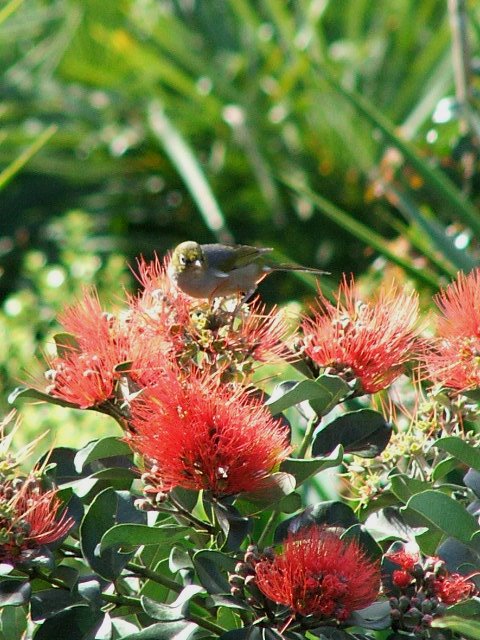
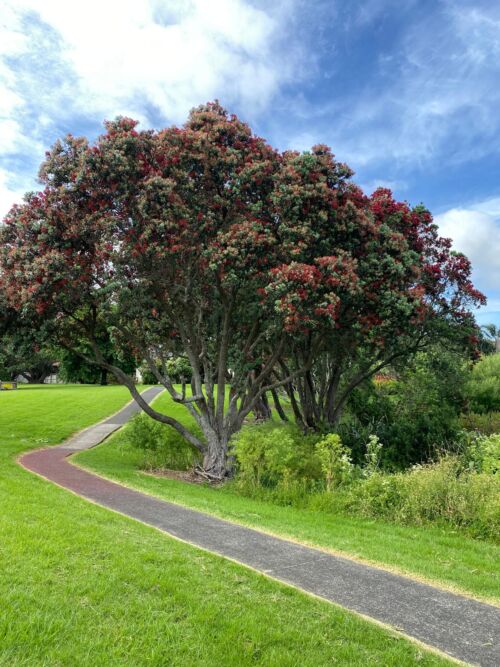
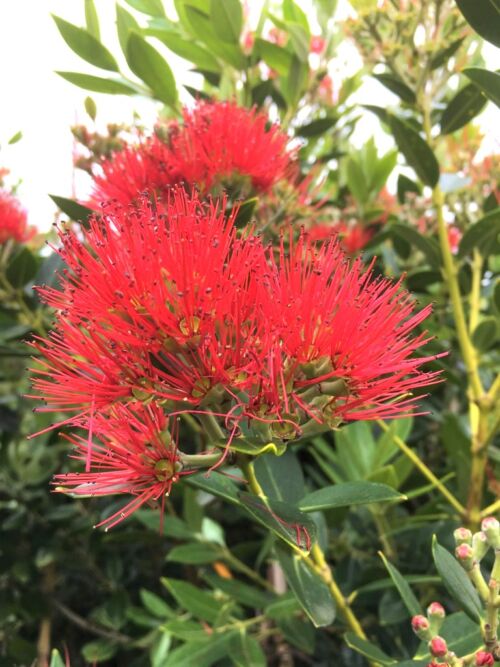
- Metrosideros excelsa, commonly known as Pohutukawa, is one of New Zealand’s most iconic native trees. Excelsa stands out as the giant of the species, with a wide-spreading canopy and olive-green foliage. From December, it bursts into bright crimson, fluffy flowers. For this reason it’s often called the New Zealand Christmas tree. Flowers also attract bees, birds, and beneficial insects. Thriving in coastal environments, Pohutukawa trees are incredibly resilient. They endure poor soil, excess moisture, and even drought. Moreover, they withstand salt-laden winds and dry, exposed landscapes. Their thick roots often anchor into cliff faces, showcasing their strength and adaptability. Pohutukawa prefers moist, well-drained earth, but will grow in a wide range of soils. With proper space, this majestic tree can grow up to 15 metres tall and 10 metres wide, making it a stunning feature in larger gardens or coastal settings.
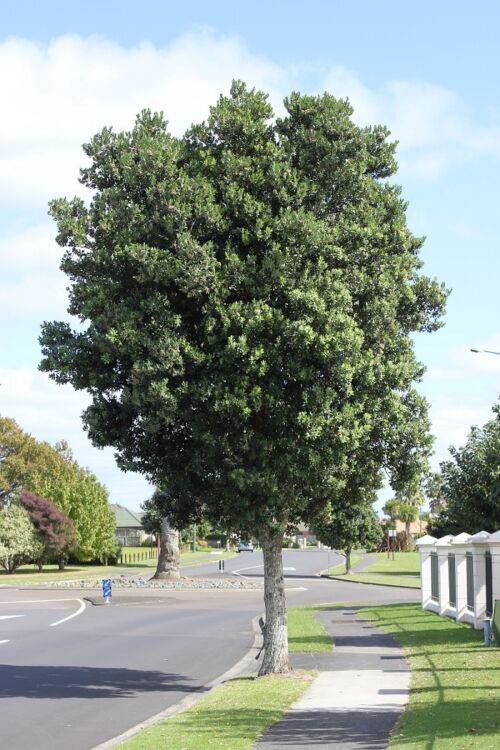
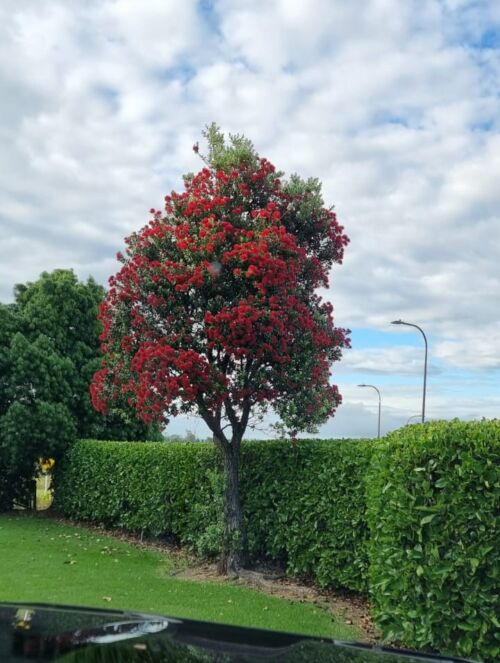
- Metrosideros excelsa 'Maori Princess' is a refined cultivar of the iconic Pohutukawa, selected for its upright, pyramidal growth habit. Its foliage is a distinctive deep green, offering a lush contrast to its vivid red flowers. Because of its compact form and neat structure, this tree is ideal for smaller gardens or urban landscapes. In addition, its tidy shape makes it easy to maintain and visually appealing year-round. In late spring, 'Maori Princess' produces brilliant red flowers that cover the tree in a spectacular display. These blooms are not only eye-catching but also serve as a valuable food source for native birds. Consequently, this tree adds both beauty and biodiversity to your garden. Growing to around 7 x 5 metres, it can be clipped to shape, making it suitable as a screen, hedge, or standout specimen. Metrosideros varieties, including 'Maori Princess', thrive in coastal environments and are impressively resilient. They tolerate poor soil, excess moisture, and even drought. Moreover, they withstand salt-laden winds and arid conditions, making them perfect for exposed sites. While they can grow in clay and wet soils, they perform best in moist, well-drained earth. Therefore, this cultivar is not only tough but also an excellent shade tree for compact outdoor spaces.
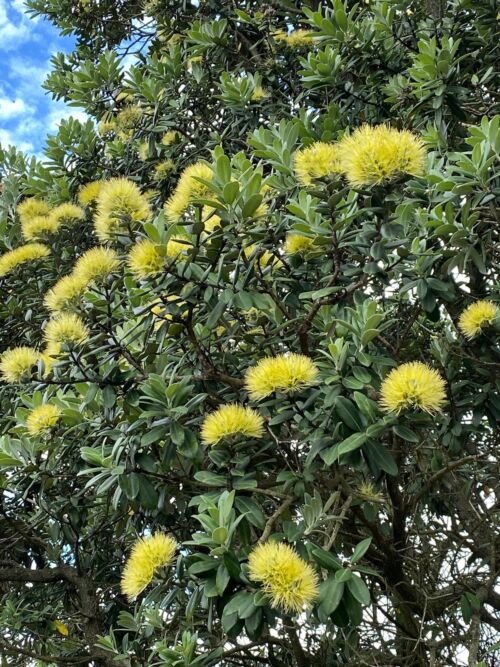
- Metrosideros excelsa 'Moon Maiden' is a striking natural hybrid of the classic New Zealand Pohutukawa. Unlike its red-flowered relatives, it blooms with sulphur-yellow flowers in December, creating a luminous display. These dazzling blossoms also produce seeds that attract and nourish small native birds, adding life and movement to your garden. As an evergreen, 'Moon Maiden' forms a broad-headed canopy, offering excellent shade. Its thick green leaves feature silver-grey undersides, adding visual depth. Metrosideros thrive in coastal environments and are impressively resilient. They endure poor soil, excess moisture, and drought, making them ideal for exposed or challenging sites. In addition, they tolerate clay and wet soils—an advantage in areas with thin or heavy ground. However, they perform best in moist, well-drained earth. Growing to approximately 6 meters tall and 5 meters wide, 'Moon Maiden' makes a stunning specimen, avenue tree or shade tree
- Metrosideros excelsa 'Scarlet Pimpernel', commonly known as Pohutukawa, is a striking member of New Zealand’s iconic native tree family. This compact evergreen variety features a bushy growth habit and smaller leaves than traditional Pohutukawa, making it ideal for smaller gardens or urban landscapes. Also known as the New Zealand Christmas tree due to its prolific flowering in December when vibrant orange-red flowers bloom which attract bees, birds, and beneficial insects. Renowned for its resilience, 'Scarlet Pimpernel' thrives in coastal environments and tolerates poor soils, excess moisture, drought, and salt-laden winds. It also adapts well to clay and wet conditions, though it prefers moist, well-drained soil for optimal growth. Perfect as a shade tree or trimmed into a screen, this hardy native grows to approximately 4 metres tall and 2 metres wide. A beautiful, low-maintenance choice for coastal and urban planting.
- Metrosideros excelsa x robusta 'Mistral', commonly known as Pohutukawa, is a stunning native tree discovered on the Coromandel Peninsula, located on the north-western coast of New Zealand’s North Island. As a natural hybrid of Metrosideros excelsa and robusta, Mistral offers a more compact and upright form. Its fresh green foliage matures into a darker shade, creating year-round interest. Moreover, its tidy growth habit makes it ideal for smaller spaces. In late spring, Mistral bursts into deep scarlet red flowers that blanket the entire tree, creating a breathtaking display. Not only are these blooms visually striking, but they also attract native birds, adding ecological value to your garden. Growing to approximately 5 x 3 metres, this tree is easily clipped into shape. Therefore, it works beautifully as a screen, hedge, or standout specimen in compact landscapes. Metrosideros varieties thrive in coastal environments and are impressively resilient. They tolerate poor soils, excess moisture, and even drought conditions. Furthermore, they withstand salt-laden winds and arid climates, making them perfect for exposed sites. While they can grow in clay and wet soils, they perform best in moist, well-drained earth. As a result, Mistral is not only hardy but also an excellent shade tree for smaller gardens.
- Metrosideros excelsa x umbellata ‘Maungapiko’ – Pohutukawa is an evergreen tree native to New Zealand. As a cross between Southern Rata and Pohutukawa, it develops a narrow, upright form with an open habit. Its slender, glossy dark‑green leaves create a striking contrast in any landscape. Bright crimson flowers appear in December and January, slightly later than most Pohutukawa varieties. This cultivar also tolerates frost better than others. Additionally, Maungapiko thrives in coastal conditions and withstand poor soils, drought, and salt‑laden winds. Although they cope with clay soils, these trees perform best in moist, well‑drained ground and full sun. Growing up to 8 metres tall and 3 metres wide, ‘Maungapiko’ makes a stunning feature for urban gardens, coastal settings, or cooler regions. Can also be used as a shelter belt.
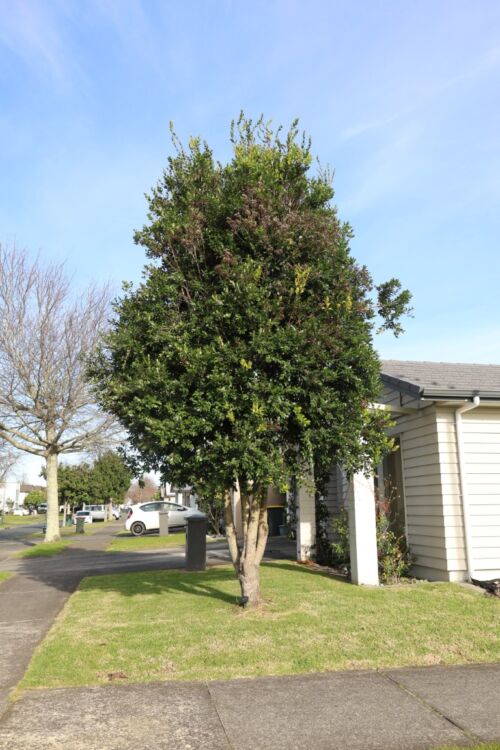
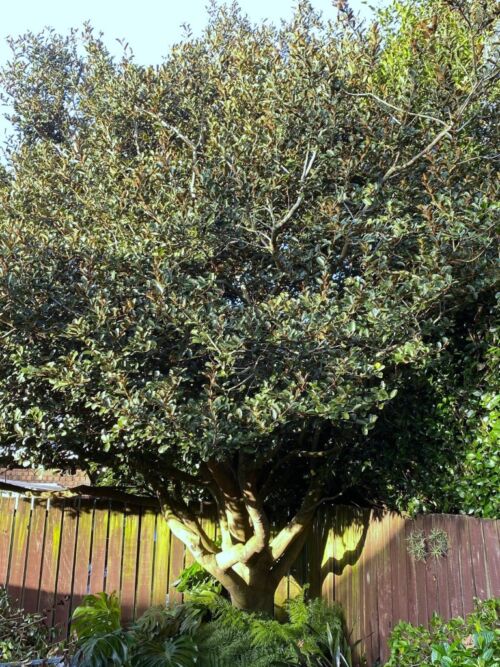
- Michelia ‘Gracipes’ is a compact, evergreen tree with a rounded form, making it ideal for smaller gardens. Its dark, olive-green leaves feature a distinctive brown felt underside, adding subtle texture and year-round interest. From late winter into early spring, this wonderful tree produces small, round, perfumed cream flowers with prominent stamens. These blooms emerge from furry brown buds, creating a charming and fragrant display. For best results, plant in moist, well-drained soil in a sheltered, sunny position. While it is slow-growing, it responds well to trimming and can be shaped into a hedge or left to grow on showcased as a specimen tree. Interestingly, Michelia ‘Gracipes’ was bred and developed in New Zealand. Although its lineage may include Chinese species such as Michelia yunnanensis, this particular cultivar is proudly of New Zealand origin. It prefers protection from strong winds so it’s well-suited to sheltered urban gardens. Reaching approximately 4 x 3 metres at maturity, it offers compact beauty and refined structure.
- Myrsine salicina – Toro is a fresh-looking, evergreen tree with a compact, upright form. Native to New Zealand, it adds year-round greenery to gardens and landscapes. Its thick, smooth, and elongated leaves give it a lush appearance. In spring, it produces clusters of small cream to pale pink flowers, followed by vibrant red to purple fruits that attract native birds. The term salicina refers to plants with narrow, pointed, willow-like leaves. Toro is ideal for coastal areas and responds well to trimming, making it easy to shape. Perfect as a small garden tree, it typically grows to around 6 meters tall and 3 meters wide. Its tidy form and resilience make it a versatile choice for various outdoor settings.
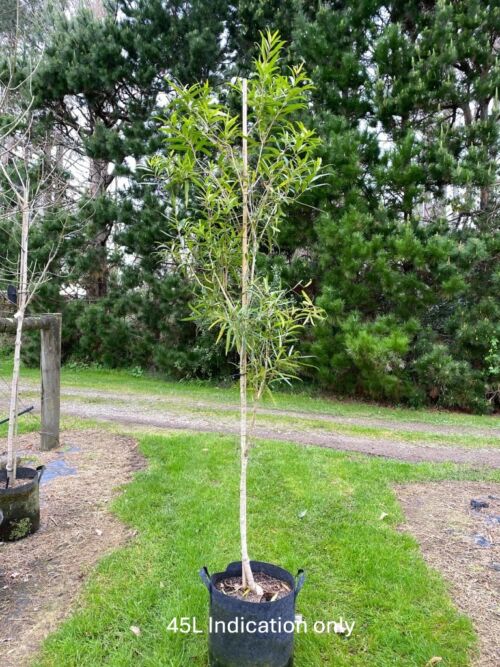
- A domed shaped tree grows readily on a clear stem, and can be maintained at a wide variety of heights. Long green linear leaves that can measure up to 100 x 10 millimetres. Slender branches. Found from coast to high altitude forest. The tree’s slender, elongated leaves give the tree a light, airy elegance.
- Nyssa sylvatica – Black Tupelo is a medium-sized, deciduous tree with a graceful pyramidal shape. Native to North America, it brings seasonal interest and structure to gardens and landscapes. During summer, its dark green, glossy leaves—oval and pointed—reach up to 15 cm long. As autumn arrives, they transform into a stunning display of reds, oranges, and yellows, making it a true standout. This tree thrives near ponds or in damp, moist areas and tolerates clay soils well. Tiny flowers bloom discreetly, followed by small blue berries that attract birds and enhance biodiversity. Typically growing to around 7 meters tall and 4 meters wide, Black Tupelo is ideal for woodland-style plantings. The name sylvatica reflects its natural habitat—thriving in forested environments..
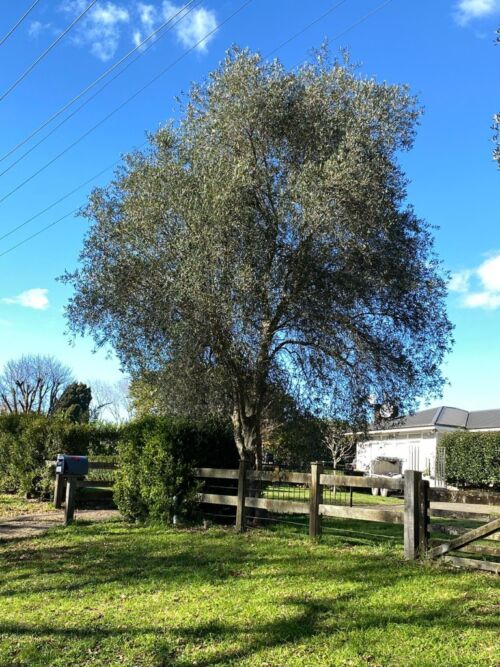
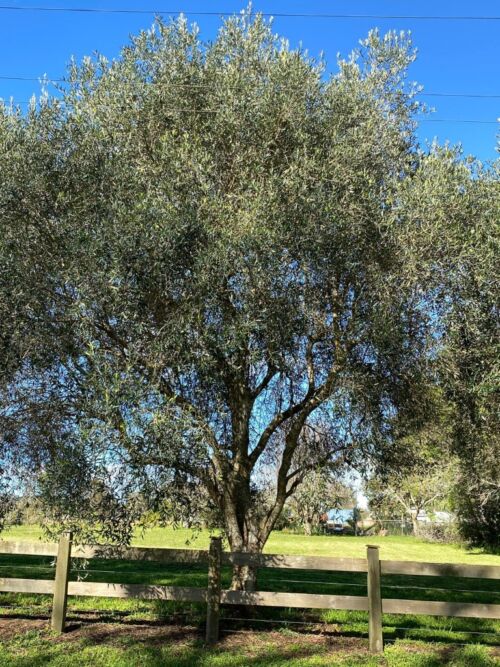
- Olea europaea, commonly known as the European olive, is a versatile and iconic tree traditionally found throughout the Mediterranean Basin. Although native to this region, it is now widely cultivated across the globe, including Australia, New Zealand, North and South America, and South Africa. Just a few of the many varieties include, Kalamata, Koroneiki, Ascolano, El Greco J5 Typically grown as a small tree, the olive is prized for its fruit, which is harvested for oil, eating, or both. Its adaptability and resilience make it a popular choice for a variety of climates and landscapes. Because it originates from the Mediterranean, Olea europaea thrives in full sun, tolerates coastal winds and extended dry periods once established. It performs well in warmer, sunny environments and is remarkably drought tolerant. In addition, it makes a beautiful lightly dappled shade tree. With a mature size of approximately 7 x 3 metres, it’s ideal for gardens, courtyards, or orchard-style plantings, bringing both ornamental charm and practical value.
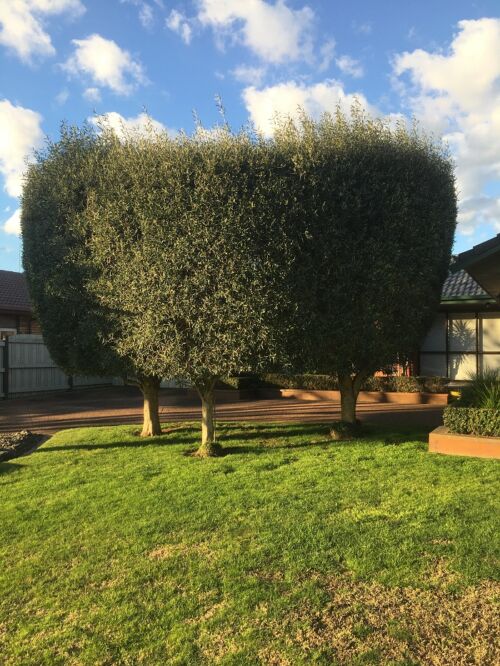
- Olea europaea ‘El Greco’ – Greek Olive is a compact evergreen olive known for its small green leaves and dense, tidy habit. Often used as a hedging olive, it may produce some fruit if left untrimmed, although this is not typical. This variety prefers moist, well‑drained soil but tolerates dry periods once established. Since it originates from the Mediterranean, it thrives in full sun and copes well with wind and coastal conditions. Because of its naturally dense, bushy form, ‘El Greco’ easily trims into neat low or tall hedges, making it ideal for smaller gardens. It grows to approximately 3 × 2 metres.
- Olea europaea ‘Ascolano’ is a rounded, moderately fast-growing evergreen with a bushy habit. It features silvery-green, leathery leaves and strong, rigid branches. This variety is well known for producing large, mild table olives, making it both ornamental and productive. Ascolano is suitable for hedging or screening and can also be left to grow as a specimen tree. When mature, it reaches approximately 6 x 3 metres, offering structure and beauty in the landscape. Originating from the Marche and Tuscany regions of Italy, Ascolano thrives in full sun and well-drained soil. Once established, it tolerates wind, coastal conditions, and dry spells, making it a hardy and versatile choice for gardens.
- Olea europaea ‘J5’ is a medium-sized, evergreen olive tree with a graceful, weeping form. Ideal for warmer climates, it adds Mediterranean charm to any garden. In spring, it bursts into masses of tiny cream-white flowers, which later develop into a generous crop of medium-sized oval fruit by autumn. This New Zealand selection thrives in full sun and tolerates wind and coastal conditions. Once established, it can endure extended dry periods, making it a resilient choice for low-maintenance landscapes. Growing to approximately 6 x 3 metres, the J5 olive tree is not only a prolific fruiter but also provides light, dappled shade—perfect for relaxing outdoor spaces.
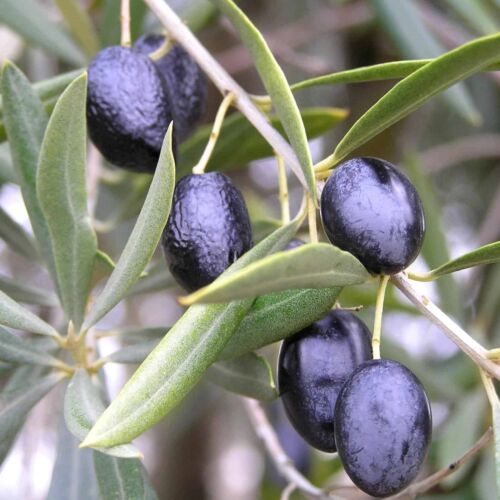
- Olea europaea ‘Kalamata’ is the famous Greek table olive tree, known for its strong vigour and upright growth habit. This striking olive tree features larger olive-green leaves compared to other varieties, adding lush texture to the landscape. During summer, clusters of small creamy white flowers appear, followed by very large, almond-shaped fruit. These dark purple olives have a smooth texture and are typically harvested in April. Notably, the name Kalamata originates from the region in southern Greece where this variety was first cultivated. As with most olive trees, the species name europaea simply means “European,” highlighting its Mediterranean heritage. In addition to its culinary fame, this tree also produces olive oil. Once established, it tolerates dry conditions well and thrives in warmer, sunny climates. With a mature size of approximately 7 x 3 metres, it makes a wonderful lightly dappled shade tree, perfect for gardens, courtyards, or orchard-style plantings. Whether you're seeking ornamental beauty or a productive fruiting tree, ‘Kalamata’ offers both elegance and utility.
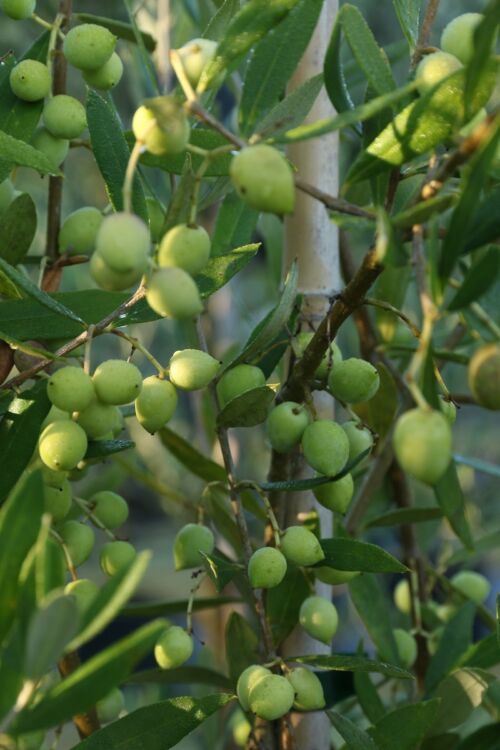
- Commercial oil Olive. Smaller leaves with dense habit. Small fruit produced in abundance with high oil content. Fruits from an early age. Will tolerate warmer climates. Being from the Mediterranean olive trees require full sun and will tolerate wind coastal and can also survive extended dry periods once established.
- Olea europaea ‘Verdale’ – Olive is an evergreen tree with a spreading, weeping form. Its long leaves show distinct green‑silver or grey‑green tones on top, while the undersides appear silvery grey. This gives the tree one of the most strikingly silvery canopies among olive varieties.Verdale originates from southern France. It is a traditional French cultivar valued for its large green olives, which are ideal for pickling. In addition, it produces a mild, fruity oil and is known for cropping reliably each season. This olive thrives in full sun and prefers moist, well‑drained soil. It also tolerates wind and coastal conditions. Once established, it can withstand extended dry periods, making it a hardy and versatile choice for many landscapes. Reaching around 5 metres, Verdale is used in commercial orchards. In residential gardens, it works beautifully as a shade tree that offers a dappled light.
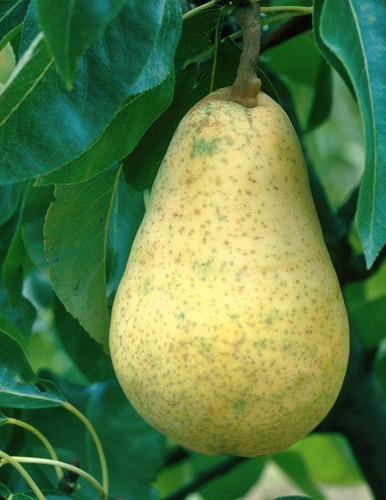
- Pear ‘ Williams Bon Chretien’ (Pyrus communis) is a large long necked, green- yellow fruit, that is ideal for eating and bottling. Harvest is apx Feb March. Branches are more horizontal making it an excellent choice for espaliering. Also known as the Bartlett pear. HERITAGE Pollinators: Beurre Bosc Winter Nelis, Conference, Doyenne du Comice.